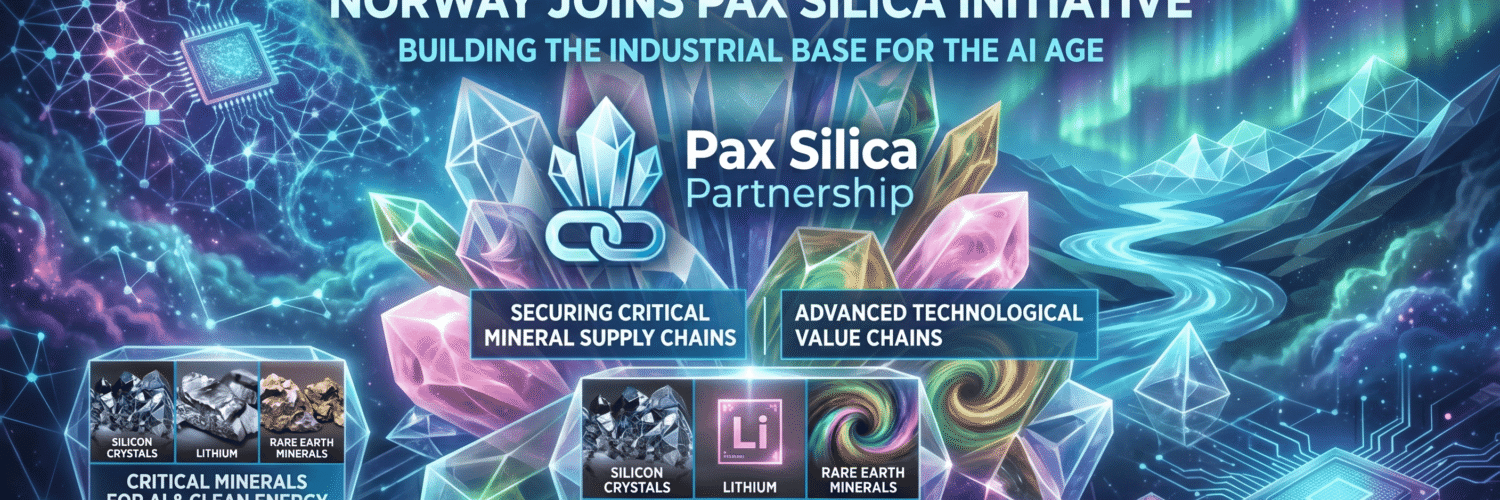
Spot: Under Secretary Jacob Helberg marks a “hinge moment” as Norway brings its merchant fleet, rare earth minerals, and hydropower to the Pax Silica coalition. This move signals a shift toward a trust-based global economy designed for the AI era—offering massive leverage for high-level entrepreneurs and govpreneurs.
WASHINGTON, D.C. — The global landscape of strategic assets shifted today as Under Secretary for Economic Affairs Jacob Helberg officially welcomed the Kingdom of Norway into the Pax Silica initiative. In a landmark ceremony at the Department of State, the U.S. and its partners solidified a coalition that Helberg described as the “industrial base the AI age will run on.”
Norway’s entry marks the 15th signatory to the pact, joining nations like the UAE, India, South Korea, and the UK in a mission to secure the supply chains and financial instruments essential for 21st-century sovereignty.
The Helberg Insight: More Than Just Minerals
In his remarks, Under Secretary Helberg underscored that Norway isn’t just joining a trade group; it is bringing “real strength” to a coalition of trusted economies. He highlighted three critical pillars that Norway contributes to the Pax Silica framework:
- Rare Earths at Fen: A vital asset for high-tech manufacturing, defense, and specialized industries.
- Hydropower & Compute Capacity: Norway’s energy surplus is positioned to underwrite the massive electrical demands of the global AI infrastructure.
- Global Shipping: Leveraging one of the world’s most important merchant fleets to ensure secure transit in a volatile geopolitical climate.
🚀 For the Entrepreneur: Capitalizing on “Trusted Capital”
For founders and CEOs operating in high-stakes sectors like pharmaceuticals, fintech, or biotechnology, Helberg’s speech provides a clear roadmap:
- Infrastructure for the AI Age: The focus is no longer just on software, but on the physical industrial base. Entrepreneurs should look toward ventures that bridge the gap between digital “compute” and physical “power.”
- Secure Financial Instruments: Helberg explicitly mentioned “financial instruments” as a pillar of Pax Silica. This opens doors for boutique advisory firms and investment models that thrive on stability and high-level international cooperation.
- A “Hinge Moment” for Investment: With rare earths and hydropower entering the “Pax Silica” trust-circle, the risk profile for long-term industrial projects in member nations is significantly lowered.
🏛️ For the Govpreneur: The Era of Strategic Statecraft
For those driving state-level partnerships and “Greenfield” visions, Norway’s accession is a masterclass in the GovPreneur philosophy:
- Building the “Trust Economy”: Helberg’s emphasis on “secure technology and secure capital” reflects the new reality where statecraft is a form of entrepreneurship. Govpreneurs can utilize this 15-nation network to pitch state-level 50/50 partnerships that align with global security standards.
- Resource Sovereignty: The mention of Norway’s hydropower and shipping fleet demonstrates how a nation can utilize its natural and logistical advantages to become an indispensable hub in a global alliance.
- Diplomacy as a Catalyst: This initiative proves that the most successful “state-level ventures” are those that provide the “industrial base” for the next technological revolution (AI).
GBP.TV Synthesis: The Industrialization of Trust
The message from Washington is unmistakable: The AI age requires a physical foundation. By bringing Norway into the fold, Pax Silica is moving beyond simple trade and toward a “Positive-Sum” industrial engine.
For the modern strategist, the opportunity lies in the “Greenfield” potential of these secure supply chains. Whether it is medicinal oil production, high-tech manufacturing, or AI data centers, the “Pax Silica” stamp is becoming the ultimate currency of trust in a fragmented world.
“Norway is not new to the trust we are building… They stand with us at this hinge moment.” — Under Secretary Jacob Helberg
Follow GBP.TV for continued analysis on how the “Pax Silica” expansion affects global capital markets and strategic industrial shifts.


9 comments